
YES (YES1) Antibody

BiCell Scientific
SKU:52419-50UL
Couldn't load pickup availability
About the Target
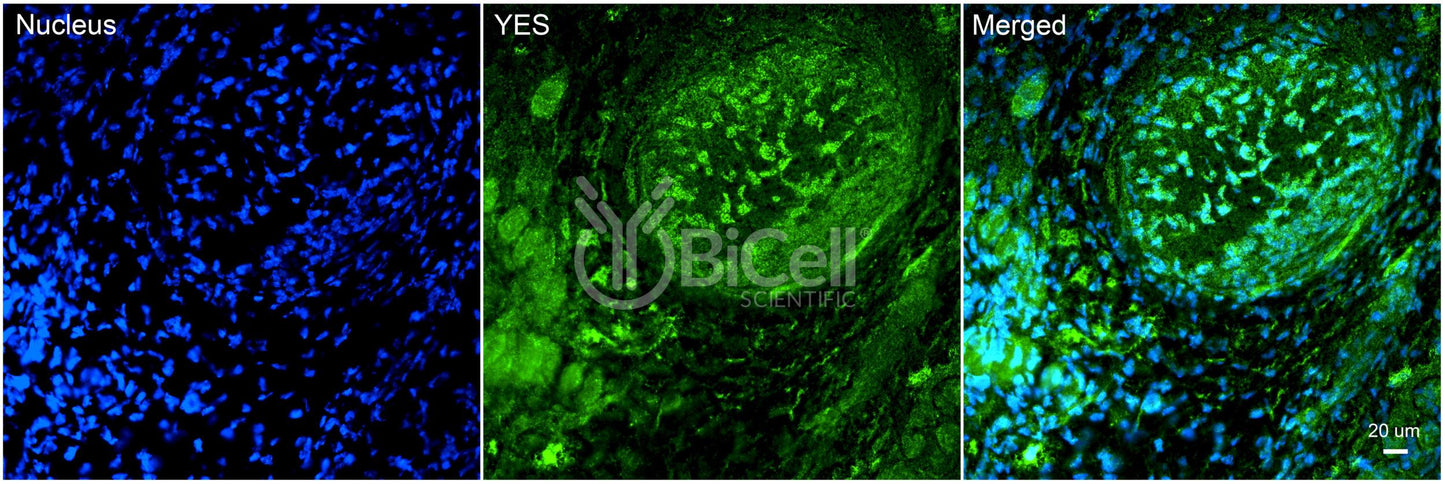
Build reproducible readouts by using this antibody to analyze YES across matched sample sets. YES is a pathway component whose activation state and localization can change after stimulation. For comparison-heavy studies, consistent sample handling and normalization help reduce run-to-run drift.
In some datasets and protocols, it is referenced by the gene symbol YES1.
Research Context
Signaling targets are typically assessed across time courses to capture transient activation windows. Define inclusion criteria and controls early so replicate sets remain interpretable as the dataset grows. In oncology research models, expression shifts can accompany changes in adhesion, signaling, or differentiation state.
Consider these angles when interpreting target-level changes:
- localization shifts between cytoplasm, membrane, and nucleus
- interaction patterns within multi-protein complexes
- condition-to-condition comparisons with matched controls
- time-resolved changes following stimulation or inhibition
Variant Considerations
If your project spans exploratory questions, the regular version offers a balanced option for establishing baseline signal behavior. This matters because epitope exposure and background can vary with preparation and extraction steps. Standardize key parameters so differences reflect biology rather than handling.
For challenging targets, pairing YES measurements with a second marker can clarify whether differences arise from regulation, redistribution, or shifts in cell composition within the sample.
To support downstream analysis, record key context variables (culture timing, stimulation window, and extraction approach) so YES patterns can be compared across experiments without guesswork.
Pair this regular format format with stable controls to keep YES measurements coherent over time.
- Targets:
- YES1
- Research Area:
- Cancer • Cell Signaling
- Application:
- IF • IHC • WB
- Reactivity:
- Human • Mouse • Rat
- Host:
- Rat
- Clonality:
- Polyclonal
- Isotype:
- IgG
- Immunogen:
- Synthetic peptide (17-aa) derived from the N-terminal region of mouse YES protein
- Conjugation:
- Unconjugated
- Purification:
- Affinity Chromatography
- Concentration:
- 0.25 mg/ml
- UniProt:
- P07947
- Homology:
- Synthetic peptide sequence is identical to rat sequence (showing 94.1% homology to human sequence)
- Storage Buffer:
- PBS, pH 7.2, 0.1% Sodium Azide
- Storage Temperature:
- -20°C