
Trpm7 Antibody - FFPE Validated


BiCell Scientific
SKU:11027-FFPE-50UL
Couldn't load pickup availability

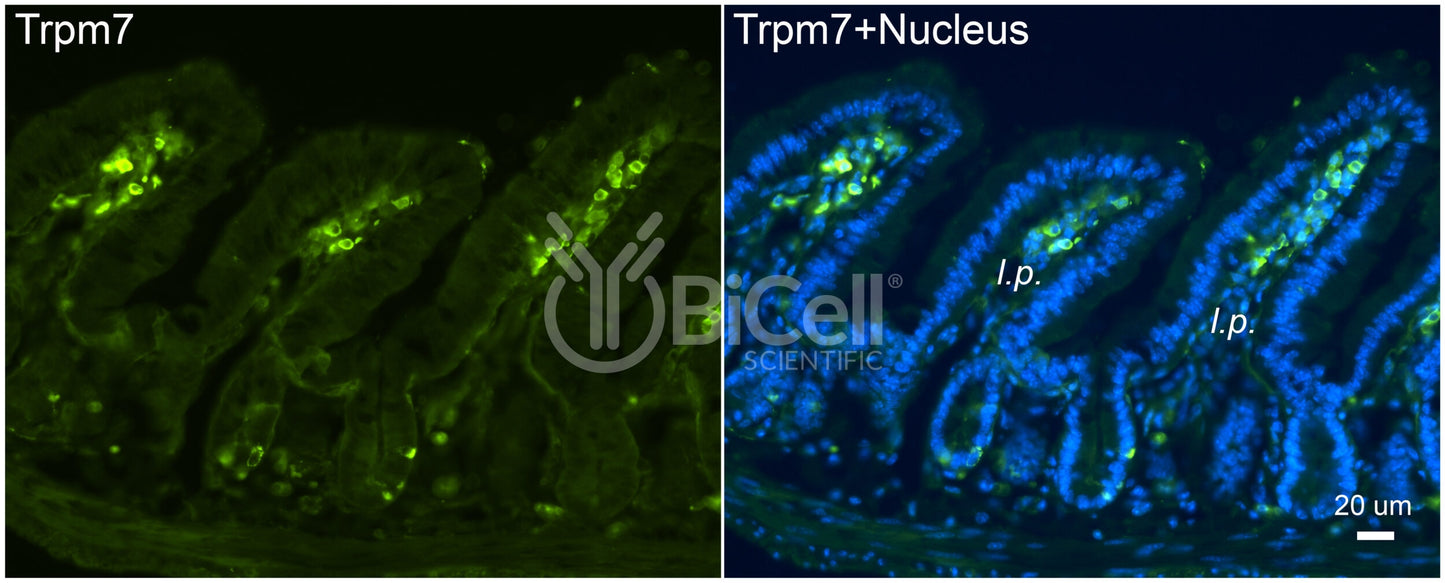
Biological Background
This antibody is suited for researchers who want to investigate Trpm7 and relate it to cell-state biology. Trpm7 is a channel or transporter associated with regulated flux across cellular membranes. Its behavior can reflect changes in differentiation state, stress, or remodeling of cellular architecture.
Following Trpm7 across perturbations can help separate expression effects from compartment shifts.
Use in the Laboratory
Transport targets are commonly studied under stimulation conditions that alter membrane potential, osmolarity, or nutrient availability. Because regulation can be multi-layered, combining abundance and localization information can sharpen conclusions.
Many targets show context-dependent localization, so comparisons across matched conditions can reveal meaningful patterns.
To keep datasets interpretable, labs often document:
- patterns consistent with apical or basolateral sorting
- stimulus-dependent trafficking and turnover
- relative abundance across engineered constructs
Version Notes
For paraffin-embedded samples, fixation history and retrieval strategy matter; this option is aligned to those constraints. If your study compares multiple conditions, keep acquisition and processing settings stable to avoid confounding. Small differences in preparation can reshape apparent localization, so interpret results in context.
For challenging targets, pairing Trpm7 measurements with a second marker can clarify whether differences arise from regulation, redistribution, or shifts in cell composition within the sample.
When interpreting Trpm7, consider whether changes track with compartment identity, cell density, or perturbation timing; these factors can influence apparent signal without implying a direct causal link.
As you refine hypotheses around Trpm7, the fixed-section format helps keep conclusions tied to preparation context.
- Targets:
- TRPM7
- Research Area:
- Cell Signaling • Neuroscience
- Application:
- IHC-P
- Reactivity:
- Human • Mouse • Rat
- Host:
- Rat
- Clonality:
- Polyclonal
- Isotype:
- IgG
- Immunogen:
- Synthetic peptide (17-aa) derived from the C-terminal region of human Trpm7 protein
- Conjugation:
- Unconjugated
- Purification:
- Affinity Chromatography
- Concentration:
- 0.25 mg/ml
- UniProt:
- Q96QT4
- Homology:
- Synthetic peptide sequence shows 94.1% homology to mouse or rat sequence
- Storage Buffer:
- PBS, pH 7.2, 0.1% Sodium Azide
- Storage Temperature:
- -20°C