
TNFSF11 (RANKL or CD254) Antibody

BiCell Scientific
SKU:52511-50UL
Couldn't load pickup availability
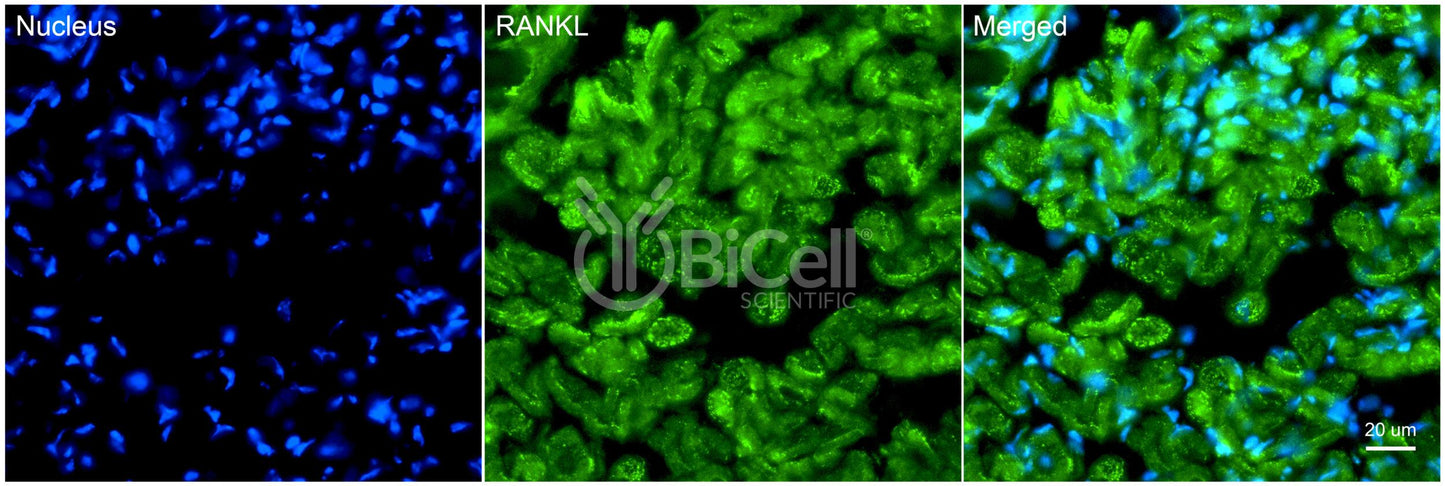
Protein Function
Use this antibody to investigate TNFSF11 (RANKL) when mapping complex behavior and signaling context. TNFSF11 is a signaling protein that can relay information through phosphorylation and complex assembly. Many projects interpret this target alongside interacting partners, upstream cues, and downstream readouts.
Monitoring TNFSF11 alongside context markers can improve interpretation when phenotypes are subtle.
Experimental Applications
Perturbations such as inhibitors or ligand stimulation can drive rapid shifts in localization or complex formation. Considering complex membership and compartment shifts can clarify whether changes reflect signaling or redistribution.
In practice, target tracking can support localization mapping, relative quantification, and interaction-focused experiments without locking you into a single readout strategy.
Common experimental questions that benefit from target tracking include:
- condition-to-condition comparisons with matched controls
- time-resolved changes following stimulation or inhibition
- interaction patterns within multi-protein complexes
Workflow Perspective
For broad method development, the regular format can help you benchmark target behavior before narrowing to a specific readout style. To keep comparisons consistent, align sample preparation steps and define a clear baseline for each series. If interactions are a focus, consider parallel readouts for key partners.
If your study spans multiple model systems, it can help to define a shared reference condition for TNFSF11 so cross-sample contrasts stay meaningful.
The regular format option supports mechanistic reading of TNFSF11 (RANKL) when interactions and context are the focus.
- Targets:
- TNFSF11
- Research Area:
- Cell Signaling • Developmental Biology • Immunology • Inflammation
- Application:
- IF • IHC • WB
- Reactivity:
- Human • Mouse • Rat
- Host:
- Rat
- Clonality:
- Polyclonal
- Isotype:
- IgG
- Immunogen:
- Synthetic peptide (14-aa) derived from the C-terminal extracellular region of mouse TNFSF11 protein
- Conjugation:
- Unconjugated
- Purification:
- Affinity Chromatography
- Concentration:
- 0.25 mg/ml
- UniProt:
- O14788
- Homology:
- Synthetic peptide sequence is identical to rat sequence (showing 92.9% homology to human sequence)
- Storage Buffer:
- PBS, pH 7.2, 0.1% Sodium Azide
- Storage Temperature:
- -20°C