
tat-nr2b9c

Selleck Chemicals
SKU:P1220-5MG
Couldn't load pickup availability
About the Target
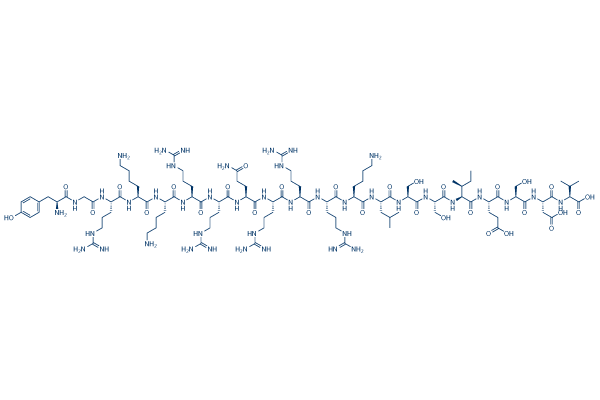
Tat-NR2B9c (Tat-NR2Bct, NA-1) is a postsynaptic density-95 (PSD-95) inhibitor, with EC50 values of 6.7 nM and 670 nM for PSD-95d2 (PSD-95 PDZ domain 2) and PSD-95d1, respectively, and disrupts the PSD-95/NMDAR interaction, inhibiting NR2A and NR2B binding to PSD-95 with IC50 values. The mapped target for this entry is PSD-95 (postsynaptic density protein 95) (DLG4). The mapped biology is best interpreted at pathway or interactome level, where the peptide is used to bias a response without assuming that every downstream change reflects exclusive engagement of one molecular species. Researchers often use this biology in neurobiology studies, where pathway perturbation can shape neuronal activity, synaptic organization, glial responses, and neurodegenerative phenotypes. In practical terms, it supports network-level interpretation of experiments that need a controlled but not oversimplified perturbation.
Research Context
Its value in research often comes from perturbing a defined protein-protein interaction, which can separate docking-dependent signaling from total target abundance. In practice, dose-response design, timing, and matched control conditions are important for separating direct target engagement from delayed compensatory responses.
- pair treatment with orthogonal pathway biomarkers whenever direct target engagement cannot be assumed
- use dose-response and time-course designs to connect early pathway shifts with later phenotypic outcomes
- frame conclusions at network level when more than one molecular node may contribute to the effect
Experimental interpretation should therefore connect early pathway changes with later phenotypic outputs, rather than relying on a single endpoint in isolation.
Format Considerations
The standard product format is most useful for reproducible baseline experiments, matched comparative studies, and workflows that need a consistent reagent across assay repeats. In comparative workflows, consistency of preparation, exposure window, and matched controls is often as important as the nominal treatment itself. This is particularly helpful for comparative experiments, benchmark studies, and orthogonal validation in which small differences in formulation or handling can complicate interpretation. For peptide-centered workflows, conclusions are usually strongest when biological readouts are paired with consistent preparation and appropriately matched reference conditions.
- Targets:
- DLG4
- CAS No.:
- 500992-11-0
- Molecular Weight:
- 2518.88
- Formula:
- C₁₀₅H₁₈₈N₄₂O₃₀
- UniProt:
- P78352
- Storage Temperature:
- -20°C
For Research Use Only. Not intended for diagnostic or therapeutic use.
Products may be subject to intellectual property rights.
The purchase of this product does not grant any license for commercial use, manufacturing, or clinical applications. The user is responsible for ensuring compliance with applicable laws and third-party rights.