
Ubiquitin Antibody

Selleck Chemicals
SKU:F3515-20UL
Couldn't load pickup availability
About the Target
Ubiquitin is a highly conserved polypeptide that plays a central role in the ubiquitin-proteasome pathway, a major mechanism for regulated protein degradation in cells. Through a process known as ubiquitination, ubiquitin is covalently attached to various cellular proteins, marking them for degradation by the 26S proteasome. Depending on the literature source, Ubiquitin may also be discussed as Ubiquitin and Ubiquitin-ribosomal protein eL40 fusion protein.
Reported cellular context includes cytoplasm, nucleus, membrane, and mitochondrion, which can matter when signal is compared across treatments or changing cell states. Following Ubiquitin across matched perturbations can help separate abundance effects from shifts in localization, complex assembly, or pathway state. In practice, this target is often considered at the family or isoform-group level, so experimental interpretation benefits from matched controls and clear comparison logic.
Research Context
Ubiquitin is commonly interpreted in the context of apoptosis research, and readouts are often stronger when a study separates expression changes from compartment-level redistribution. When reported signal spans cytoplasm, nucleus, and membrane, a defined reference condition can make comparisons more interpretable across perturbations, passages, or replicate sets.
Consider these angles when interpreting target-level changes:
- apparent redistribution between cytoplasm, nucleus, and membrane across matched conditions
- separation of survival-associated changes from stress or death-associated readouts
- co-patterning with orthogonal markers and control conditions that clarify pathway state
- time-matched comparisons so changes reflect biology rather than handling or sampling drift
Variant Considerations
If your project spans exploratory questions, the regular version offers a balanced option for establishing baseline signal behavior for Ubiquitin. This can help when protocols evolve over time and the goal is to compare experiments using a stable reference workflow.
Standardize sampling time, control choice, and downstream analysis thresholds so apparent differences in Ubiquitin reflect biology rather than handling. When interpreting Ubiquitin, it is often useful to decide early whether the main question is overall abundance, compartmental enrichment, or context-dependent redistribution.
For multi-run studies, a shared reference condition can keep Ubiquitin trends easier to compare across datasets. That kind of consistency is especially helpful when follow-up work expands to new perturbations, model systems, or longitudinal collections.
- Targets:
- RPS27A • UBA52 • UBB • UBC
- Research Area:
- Apoptosis
- Application:
- IHC • WB
- Specificity:
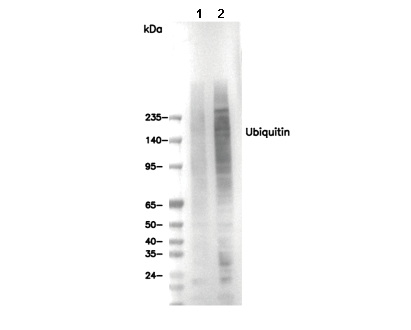
- Ubiquitin Antibody [D15B4] detects endogenous levels of total ubiquitin, polyubiquitin and ubiquitinated proteins.
- Host:
- Mouse
- Clonality:
- Monoclonal
- Clone:
- D15B4
- Storage Buffer:
- PBS, pH 7.2+50% Glycerol+0.05% BSA+0.01% NaN₃
- Storage Temperature:
- -20°C
For Research Use Only. Not intended for diagnostic or therapeutic use.
Products may be subject to intellectual property rights.
The purchase of this product does not grant any license for commercial use, manufacturing, or clinical applications. The user is responsible for ensuring compliance with applicable laws and third-party rights.