
PIK3CG (PI3K-gamma or p110-gamma) Antibody - FFPE Validated

BiCell Scientific
SKU:52733-FFPE-50UL
Couldn't load pickup availability
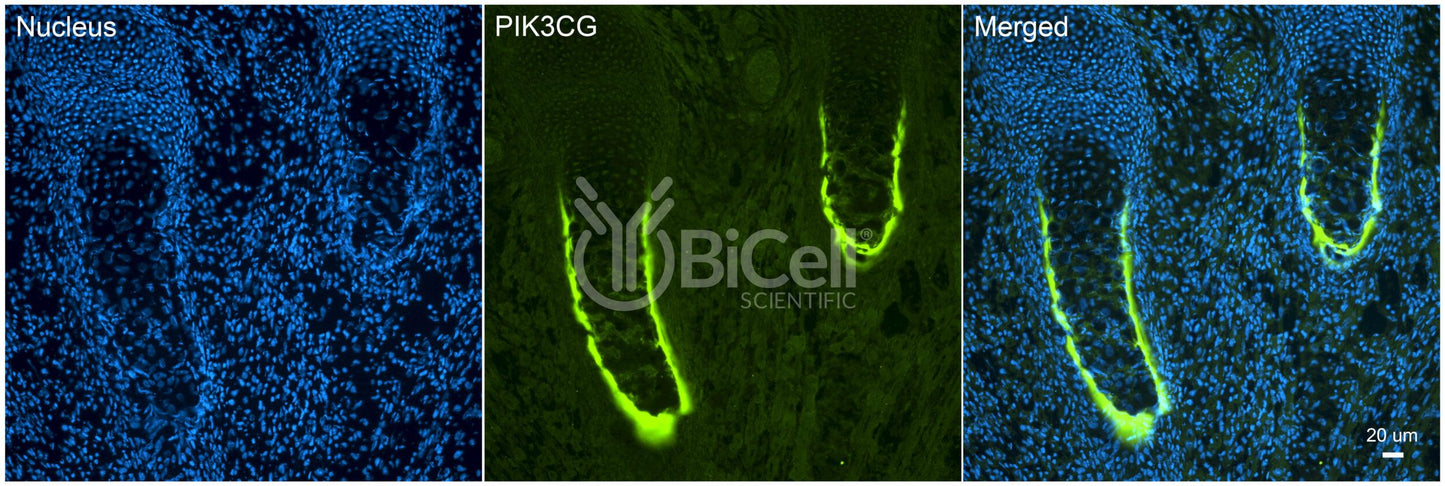
Scientific Overview
Build reproducible readouts by using this antibody to evaluate PIK3CG (PI3K-gamma) across matched sample sets. PIK3CG is a signaling protein that can relay information through phosphorylation and complex assembly. Use matched handling so differences reflect biology rather than processing.
Monitoring PIK3CG alongside context markers can improve interpretation when phenotypes are subtle.
Research Relevance
When comparing conditions, consistent sample handling and normalization are key for meaningful contrasts. Define inclusion criteria and controls early so replicate sets remain interpretable as the dataset grows.
Because cellular networks are interconnected, changes in this target may coincide with shifts in related pathways, trafficking behavior, or structural remodeling.
When building a narrative around the target, it helps to track:
- localization shifts between cytoplasm, membrane, and nucleus
- interaction patterns within multi-protein complexes
- time-resolved changes following stimulation or inhibition
- condition-to-condition comparisons with matched controls
Application-Specific Context
Because fixation can mask epitopes, fixed-section oriented formats aim to maintain recognition after standard deparaffinization and retrieval steps. Think about how preparation affects epitope accessibility, and interpret patterns alongside morphology and compartment markers as needed. A short pilot series can help set exposure ranges and reduce reruns.
When interpreting PIK3CG, consider whether changes track with compartment identity, cell density, or perturbation timing; these factors can influence apparent signal without implying a direct causal link.
With consistent handling, the fixed-section format can make PIK3CG (PI3K-gamma) comparisons easier to reproduce across runs.
- Targets:
- PIK3CG
- Research Area:
- Cell Signaling • Metabolism
- Application:
- IHC-P
- Reactivity:
- Human • Mouse • Rat
- Host:
- Rat
- Clonality:
- Polyclonal
- Isotype:
- IgG
- Immunogen:
- Synthetic peptide (16-aa) derived from the C-terminal region of human PIK3CG protein
- Conjugation:
- Unconjugated
- Purification:
- Affinity Chromatography
- Concentration:
- 0.25 mg/ml
- UniProt:
- P48736
- Homology:
- Synthetic peptide sequence is identical to mouse or rat sequence
- Storage Buffer:
- PBS, pH 7.2, 0.1% Sodium Azide
- Storage Temperature:
- -20°C