
Myelin Oligodendrocyte Glycoprotein 35-55 (Mouse, Rat)

Selleck Chemicals
SKU:P1204-5MG
Couldn't load pickup availability
About the Target
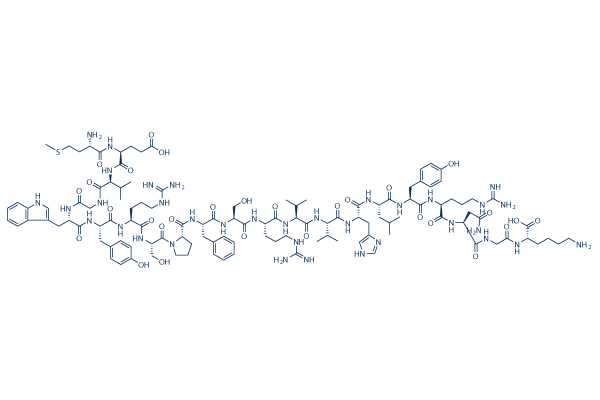
Myelin Oligodendrocyte Glycoprotein 35-55, mouse, rat (MOG 35-55) is a minor component of CNS myelin that induces experimental autoimmune encephalomyelitis in C57BL/6 mice by an encephalitogenic T cell response. The mapped biological anchor for this entry is Myelin oligodendrocyte glycoprotein (source antigen) (MOG), although the description suggests that interpretation should remain at fragment, family, or pathway level. Here the product is best viewed as a defined fragment or protein-derived reagent, which helps isolate aggregation behavior, antigenicity, binding interfaces, or stress-related biology from the full-length precursor context. Researchers commonly study this context in immunology settings, where perturbation can reshape cytokine output, leukocyte activation state, and inflammatory remodeling. This framing is especially useful when investigators need a defined fragment model rather than the full-length precursor context.
Research Context
Because it is an antigenic fragment, this reagent is usually used to model epitope-specific recognition or disease-associated immune activation rather than receptor pharmacology. In practice, handling conditions, timing, and matched controls are important for separating fragment-dependent effects from responses driven by broader precursor or pathway biology. When species annotation matters, keeping comparisons within the stated mouse; rat context helps reduce ambiguity in receptor or sequence preference. Because the enrichment is not fully single-target, conclusions are usually strongest when they are framed around the intended biological process and confirmed with orthogonal markers.
- treat the reagent as a defined fragment model rather than as a full-length-protein substitute
- control handling conditions that can influence aggregation state, epitope presentation, or interface exposure
- interpret downstream phenotypes together with assays that confirm the relevant fragment-dependent state
Experimental interpretation should therefore connect early pathway changes with later phenotypic outputs, rather than relying on a single endpoint in isolation.
Format Considerations
Using the regular format helps keep comparative experiments aligned, especially when the same signaling question is being tested across multiple models or readout platforms. In comparative workflows, retaining the annotated mouse; rat species context helps when comparing sequence-dependent biology. This is particularly helpful for comparative experiments, benchmark studies, and orthogonal validation in which small differences in formulation or handling can complicate interpretation. For peptide-centered workflows, conclusions are usually strongest when biological readouts are paired with consistent preparation and appropriately matched reference conditions.
- Targets:
- MOG
- CAS No.:
- 149635-73-4
- Molecular Weight:
- 2581.95
- Formula:
- C₁₁₈H₁₇₇N₃₅O₂₉S
- UniProt:
- Q16653
- Storage Temperature:
- -20°C
For Research Use Only. Not intended for diagnostic or therapeutic use.
Products may be subject to intellectual property rights.
The purchase of this product does not grant any license for commercial use, manufacturing, or clinical applications. The user is responsible for ensuring compliance with applicable laws and third-party rights.