
LLGL1 (LGL1) Antibody

BiCell Scientific
SKU:00271-50UL
Couldn't load pickup availability
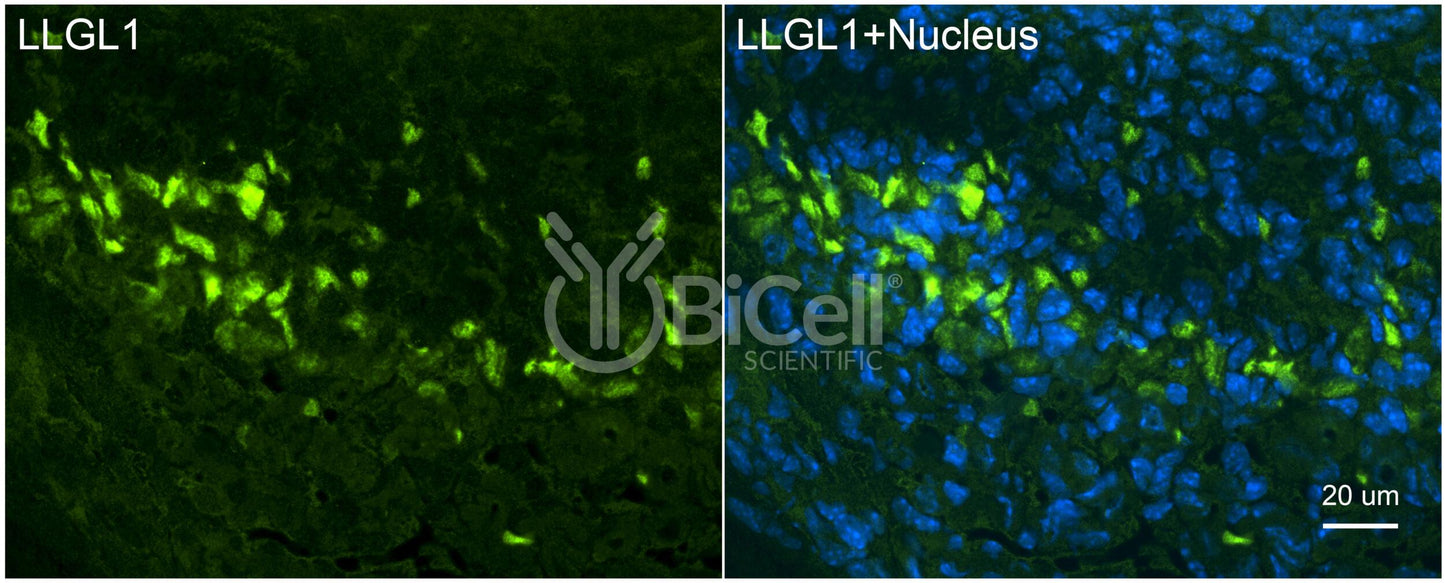
Scientific Overview
Plan your comparisons around LLGL1 and use this antibody to examine state-dependent differences. LLGL1 is a pathway component whose activation state and localization can change after stimulation. Plan positive and negative controls that match your model system, including perturbations expected to shift the target.
Monitoring LLGL1 alongside context markers can improve interpretation when phenotypes are subtle.
Research Relevance
Perturbations such as inhibitors or ligand stimulation can drive rapid shifts in localization or complex formation. Time course design can be decisive when regulation is transient or compartment dependent.
Since many cellular processes are coupled, measured differences can reflect both direct regulation and indirect effects from broader state changes.
When building a narrative around the target, it helps to track:
- time-resolved changes following stimulation or inhibition
- localization shifts between cytoplasm, membrane, and nucleus
- condition-to-condition comparisons with matched controls
Application-Specific Context
This regular format is a practical starting point when you want flexibility across sample types and iterative optimization. Think about how preparation affects epitope accessibility, and interpret patterns alongside morphology and compartment markers as needed. Align controls to the expected direction of change to support confident interpretation.
For challenging targets, pairing LLGL1 measurements with a second marker can clarify whether differences arise from regulation, redistribution, or shifts in cell composition within the sample.
Integrate the regular format version into your design so LLGL1 signals can be interpreted alongside matched controls.
- Targets:
- LLGL1
- Research Area:
- Cell Signaling • Developmental Biology
- Application:
- IF • IHC • WB
- Reactivity:
- Human • Mouse • Rat
- Host:
- Rat
- Clonality:
- Polyclonal
- Isotype:
- IgG
- Immunogen:
- Synthetic peptide (15-aa) derived from the C-terminal region of mouse LLGL1 protein
- Conjugation:
- Unconjugated
- Purification:
- Affinity Chromatography
- Concentration:
- 0.25 mg/ml
- UniProt:
- Q15334
- Homology:
- Synthetic peptide sequence is identical to rat sequence (showing 93.3% homology to human sequence)
- Storage Buffer:
- PBS, pH 7.2, 0.1% Sodium Azide
- Storage Temperature:
- -20°C