
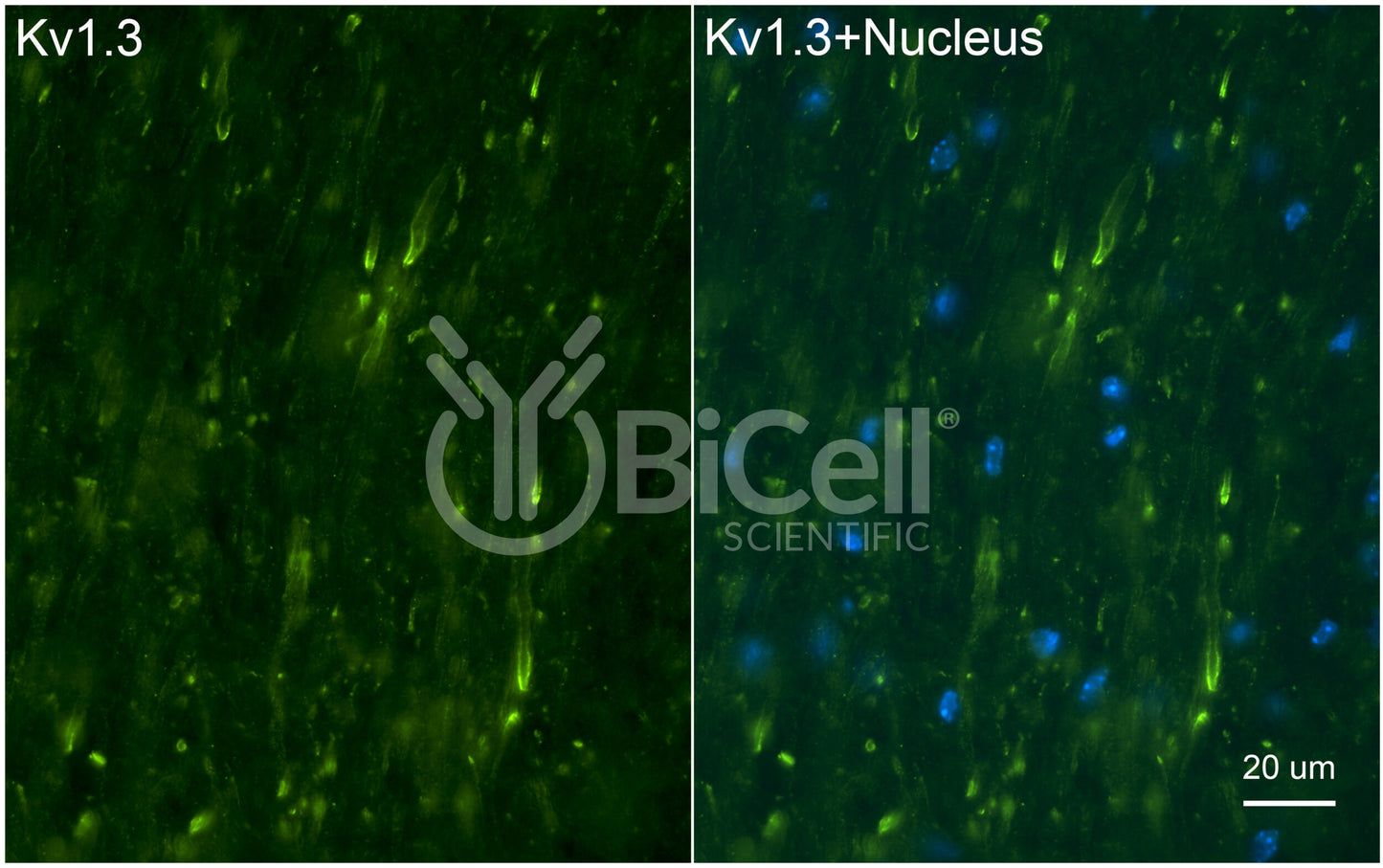
KCNA3 (Kv1.3) Antibody - FFPE Validated


BiCell Scientific
SKU:20223-FFPE-50UL
Couldn't load pickup availability


About the Target
Plan your comparisons around KCNA3 and use this antibody to examine state-dependent differences. KCNA3 is a channel or transporter associated with regulated flux across cellular membranes. Plan positive and negative controls that match your model system, including perturbations expected to shift the target.
Tracking KCNA3 can clarify whether changes reflect regulation, redistribution, or altered complex assembly.
Research Context
Transport targets are commonly studied under stimulation conditions that alter membrane potential, osmolarity, or nutrient availability. Time course design can be decisive when regulation is transient or compartment dependent. Neural differentiation and synaptic organization projects may include this target as a contextual readout.
Consider these angles when interpreting target-level changes:
- surface versus intracellular pool distribution
- patterns consistent with apical or basolateral sorting
- stimulus-dependent trafficking and turnover
Variant Considerations
Because fixation can mask epitopes, fixed-section oriented formats aim to maintain recognition after standard deparaffinization and retrieval steps. This matters because epitope exposure and background can vary with preparation and extraction steps. Include controls that separate true target shifts from matrix or preparation effects.
When interpreting KCNA3, consider whether changes track with compartment identity, cell density, or perturbation timing; these factors can influence apparent signal without implying a direct causal link.
To support downstream analysis, record key context variables (culture timing, stimulation window, and extraction approach) so KCNA3 patterns can be compared across experiments without guesswork.
Integrate the fixed-section version into your design so KCNA3 signals can be interpreted alongside matched controls.
- Targets:
- KCNA3
- Research Area:
- Neuroscience
- Application:
- IHC-P
- Reactivity:
- Human • Mouse • Rat
- Host:
- Rabbit
- Clonality:
- Polyclonal
- Isotype:
- IgG
- Immunogen:
- Synthetic peptide (14-aa) derived from the C-terminal region of human Kv1.3 protein
- Conjugation:
- Unconjugated
- Purification:
- Affinity Chromatography
- Concentration:
- 0.25 mg/ml
- UniProt:
- P22001
- Homology:
- Synthetic peptide sequence is identical to mouse or rat sequence
- Storage Buffer:
- PBS, pH 7.2, 0.1% Sodium Azide
- Storage Temperature:
- -20°C