
GLUT1 (SLC2A1) Antibody - FFPE Validated


BiCell Scientific
SKU:20701-FFPE-50UL
Couldn't load pickup availability


Protein Function
To connect mechanism with measurement, this antibody lets you investigate GLUT1 in pathway-driven studies. GLUT1 is a structural regulator of intercellular boundaries and tissue architecture. Many projects interpret this target alongside interacting partners, upstream cues, and downstream readouts.
Tracking GLUT1 can clarify whether changes reflect regulation, redistribution, or altered complex assembly.
Experimental Applications
Junction proteins are frequently analyzed during differentiation, stress responses, and changes in cell polarity. Considering complex membership and compartment shifts can clarify whether changes reflect signaling or redistribution.
In practice, target tracking can support localization mapping, relative quantification, and interaction-focused experiments without locking you into a single readout strategy. Blood-brain barrier models often monitor junction regulation alongside permeability-focused measurements.
Common experimental questions that benefit from target tracking include:
- comparative profiling across cell states or perturbations
- changes in complex assembly with scaffold or adaptor proteins
- co-localization patterns with cytoskeletal elements
Workflow Perspective
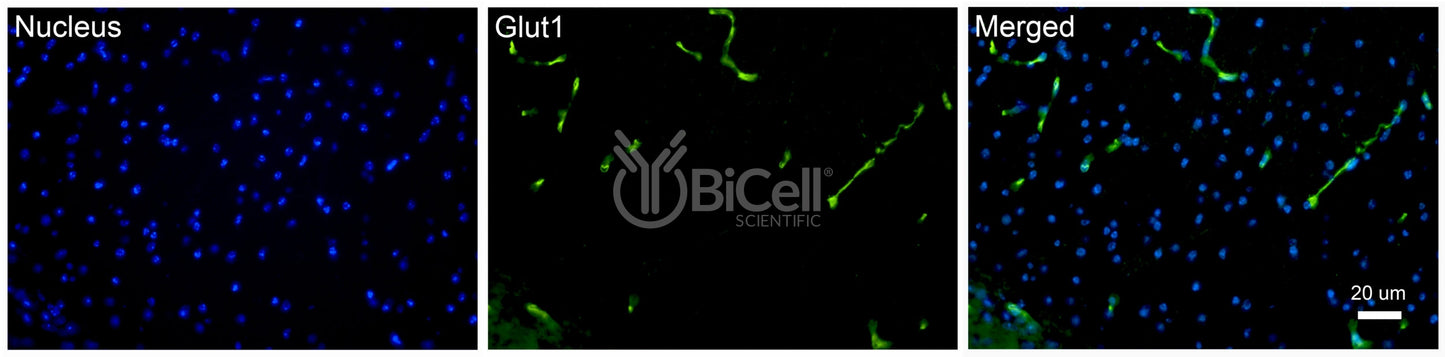
In sectioned tissue workflows, interpretation often depends on morphology; this format supports that style of readout. To keep comparisons consistent, align sample preparation steps and define a clear baseline for each series. If interactions are a focus, consider parallel readouts for key partners.
When interpreting GLUT1, consider whether changes track with compartment identity, cell density, or perturbation timing; these factors can influence apparent signal without implying a direct causal link.
Use the fixed-section version to relate GLUT1 behavior to upstream cues and downstream consequences.
- Targets:
- SLC2A1
- Research Area:
- Cardiovascular • Developmental Biology • Metabolism • Neuroscience
- Application:
- IHC-P
- Reactivity:
- Human • Mouse • Rat
- Host:
- Rabbit
- Clonality:
- Polyclonal
- Isotype:
- IgG
- Immunogen:
- Synthetic peptide (14-aa) derived from the C-terminal region of human GLUT1 protein
- Conjugation:
- Unconjugated
- Purification:
- Affinity Chromatography
- Concentration:
- 0.25 mg/ml
- UniProt:
- P11166
- Homology:
- Synthetic peptide sequence is identical to mouse or rat sequence
- Storage Buffer:
- PBS, pH 7.2, 0.1% Sodium Azide
- Storage Temperature:
- -20°C