
FGR (SRC2) Antibody - FFPE Validated

BiCell Scientific
SKU:52412-FFPE-50UL
Couldn't load pickup availability
Protein Function
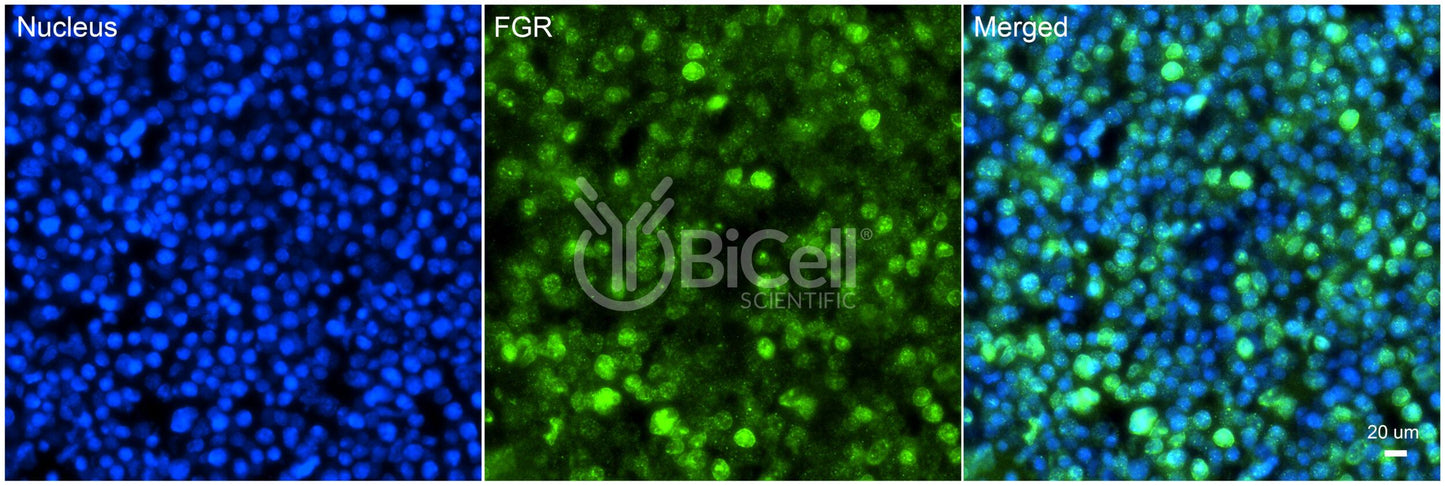
When control selection matters, this antibody helps you investigate FGR (SRC2) in a structured study. FGR is a pathway component whose activation state and localization can change after stimulation. Plan positive and negative controls that match your model system, including perturbations expected to shift the target.
In some datasets and protocols, it is referenced by the gene symbol SRC2.
Experimental Applications
Signaling targets are typically assessed across time courses to capture transient activation windows. Time course design can be decisive when regulation is transient or compartment dependent.
In practice, target tracking can support localization mapping, relative quantification, and interaction-focused experiments without locking you into a single readout strategy. In oncology research models, expression shifts can accompany changes in adhesion, signaling, or differentiation state.
Common experimental questions that benefit from target tracking include:
- localization shifts between cytoplasm, membrane, and nucleus
- time-resolved changes following stimulation or inhibition
- interaction patterns within multi-protein complexes
Workflow Perspective
Because fixation can mask epitopes, fixed-section oriented formats aim to maintain recognition after standard deparaffinization and retrieval steps. To keep comparisons consistent, align sample preparation steps and define a clear baseline for each series. Predefine acceptance criteria for controls before collecting the full dataset.
For challenging targets, pairing FGR measurements with a second marker can clarify whether differences arise from regulation, redistribution, or shifts in cell composition within the sample.
The fixed-section format fits designs where FGR (SRC2) is evaluated with deliberate controls and careful comparisons.
- Targets:
- FGR
- Research Area:
- Cancer • Cell Signaling
- Application:
- IHC-P
- Reactivity:
- Human • Mouse • Rat
- Host:
- Rat
- Clonality:
- Polyclonal
- Isotype:
- IgG
- Immunogen:
- Synthetic peptide (16-aa) derived from the N-terminal region of mouse FGR protein
- Conjugation:
- Unconjugated
- Purification:
- Affinity Chromatography
- Concentration:
- 0.25 mg/ml
- UniProt:
- P09769
- Homology:
- Synthetic peptide sequence is identical to rat sequence (showing 87.5% homology to human sequence)
- Storage Buffer:
- PBS, pH 7.2, 0.1% Sodium Azide
- Storage Temperature:
- -20°C