
CELSR3 (CDHF11 or FMI1) Antibody - FFPE Validated


BiCell Scientific
SKU:50803-FFPE-50UL
Couldn't load pickup availability


Protein Function
Build reproducible readouts by using this antibody to explore CELSR3 (FMI1) across matched sample sets. CELSR3 is a membrane-associated component that helps organize cell-cell contacts and polarity. For comparison-heavy studies, consistent sample handling and normalization help reduce run-to-run drift.
In some datasets and protocols, it is referenced by the gene symbol FMI1.
Experimental Applications
Junction proteins are frequently analyzed during differentiation, stress responses, and changes in cell polarity. Define inclusion criteria and controls early so replicate sets remain interpretable as the dataset grows.
Many workflows benefit from tracking both signal intensity and compartment distribution, especially when the target participates in multi-protein assemblies. Planar polarity studies may connect this target to directional signaling and cytoskeletal alignment.
Common experimental questions that benefit from target tracking include:
- comparative profiling across cell states or perturbations
- changes in complex assembly with scaffold or adaptor proteins
- co-localization patterns with cytoskeletal elements
- subcellular redistribution at contact sites versus cytoplasm
Workflow Perspective
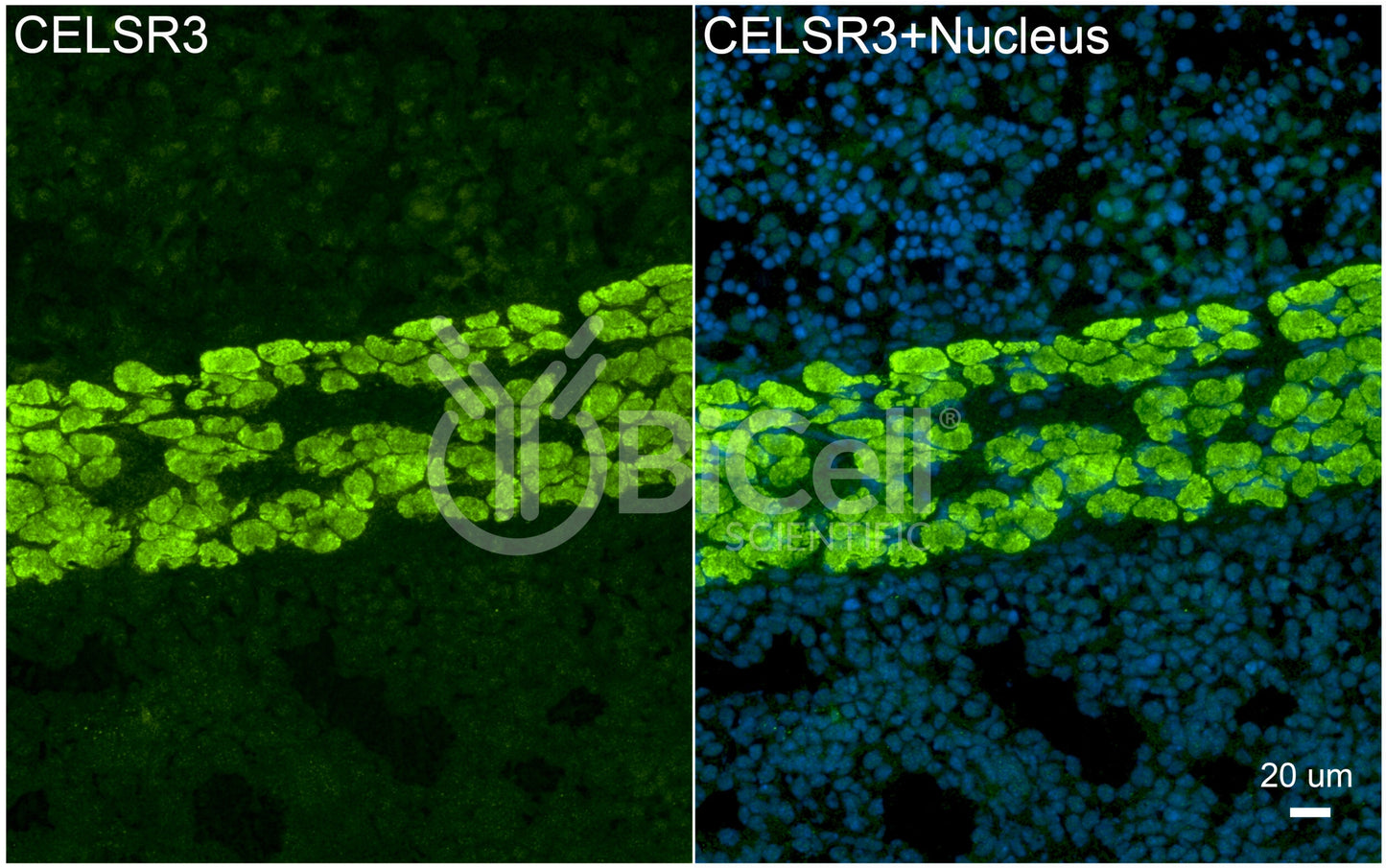
This fixed-section oriented version is intended for paraffin-embedded tissue, where crosslinking and retrieval steps can shape epitope accessibility. To keep comparisons consistent, align sample preparation steps and define a clear baseline for each series. Document normalization choices so collaborators can reproduce the same interpretation.
To support downstream analysis, record key context variables (culture timing, stimulation window, and extraction approach) so CELSR3 patterns can be compared across experiments without guesswork.
With consistent handling, the fixed-section format can make CELSR3 (FMI1) comparisons easier to reproduce across runs.
- Targets:
- CELSR3
- Research Area:
- Cell Signaling • Developmental Biology • Neuroscience
- Application:
- IHC-P
- Reactivity:
- Human • Mouse • Rat
- Host:
- Rabbit
- Clonality:
- Polyclonal
- Isotype:
- IgG
- Immunogen:
- Synthetic peptide (12-aa) derived from the C-terminal region of human CELSR3 protein
- Conjugation:
- Unconjugated
- Purification:
- Affinity Chromatography
- Concentration:
- 0.25 mg/ml
- UniProt:
- Q9NYQ7
- Homology:
- Synthetic peptide sequence is identical to mouse or rat sequence
- Storage Buffer:
- PBS, pH 7.2, 0.1% Sodium Azide
- Storage Temperature:
- -20°C