
CELSR1 (CDHF9 or FMI2) Antibody - FFPE Validated


BiCell Scientific
SKU:50801-FFPE-50UL
Couldn't load pickup availability

Scientific Overview
Bring CELSR1 into view to examine changes across conditions. CELSR1 is a junctional protein that coordinates adhesion with cytoskeletal anchoring. Focus on trends across conditions rather than single-point snapshots.
In some datasets and protocols, it is referenced by the gene symbol FMI2.
Research Relevance
Researchers often monitor junctional targets when studying epithelial integrity, remodeling, and motility. Pair measurements with orthogonal readouts when interpretation is sensitive to context.
Since many cellular processes are coupled, measured differences can reflect both direct regulation and indirect effects from broader state changes. Planar polarity studies may connect this target to directional signaling and cytoskeletal alignment.
When building a narrative around the target, it helps to track:
- subcellular redistribution at contact sites versus cytoplasm
- comparative profiling across cell states or perturbations
- changes in complex assembly with scaffold or adaptor proteins
- co-localization patterns with cytoskeletal elements
Application-Specific Context
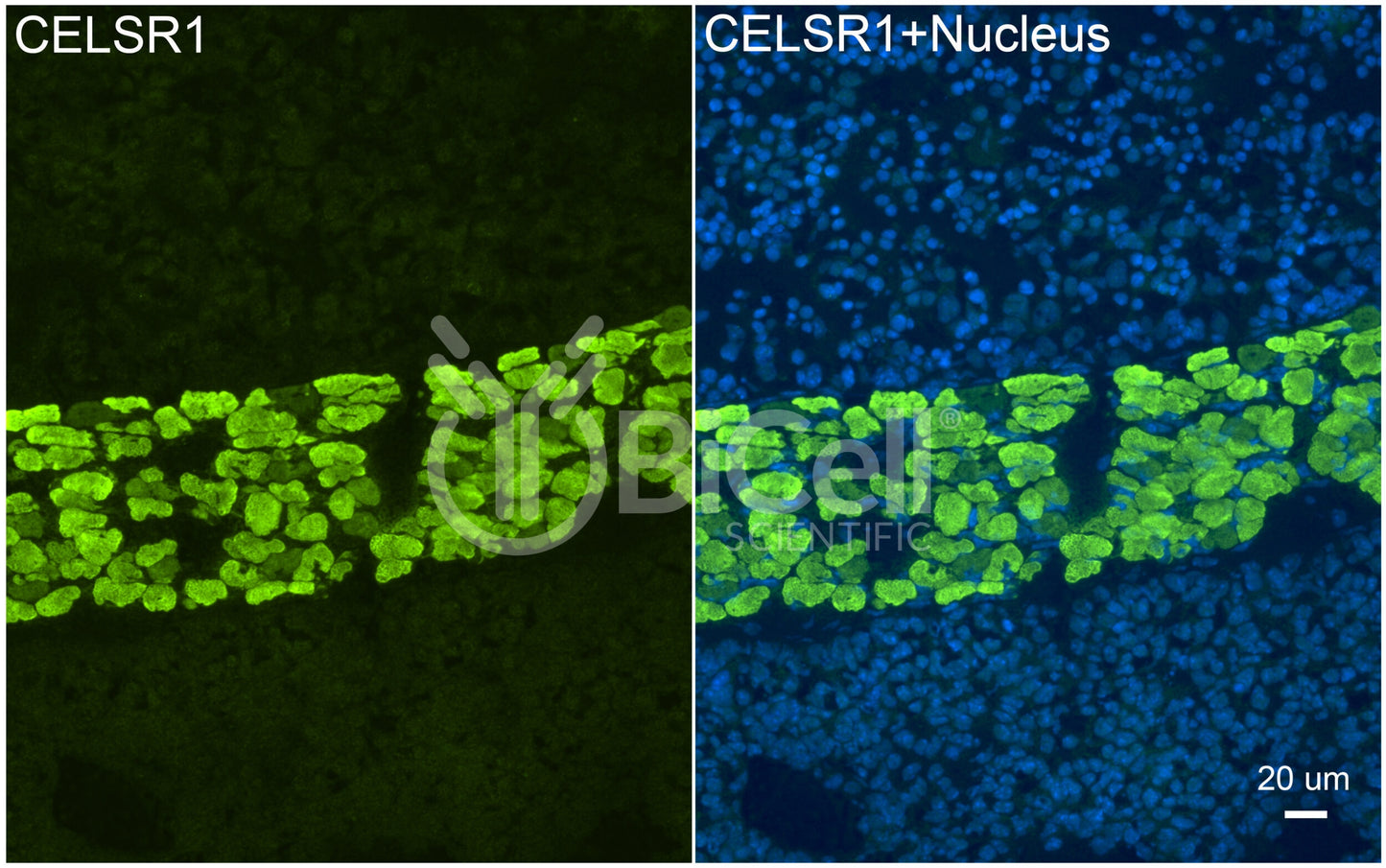
This fixed-section oriented version is intended for paraffin-embedded tissue, where crosslinking and retrieval steps can shape epitope accessibility. Think about how preparation affects epitope accessibility, and interpret patterns alongside morphology and compartment markers as needed.
For challenging targets, pairing CELSR1 measurements with a second marker can clarify whether differences arise from regulation, redistribution, or shifts in cell composition within the sample.
For challenging targets, pairing CELSR1 measurements with a second marker can clarify whether differences arise from regulation, redistribution, or shifts in cell composition within the sample.
Select the fixed-section version to keep CELSR1 interpretation aligned with your workflow goals.
- Targets:
- CELSR1
- Research Area:
- Cell Signaling • Developmental Biology • Neuroscience
- Application:
- IHC-P
- Reactivity:
- Human • Mouse • Rat
- Host:
- Rabbit
- Clonality:
- Polyclonal
- Isotype:
- IgG
- Immunogen:
- Synthetic peptide (13-aa) derived from the C-terminal region of mouse CELSR1 protein
- Conjugation:
- Unconjugated
- Purification:
- Affinity Chromatography
- Concentration:
- 0.25 mg/ml
- UniProt:
- Q9NYQ6
- Homology:
- Synthetic peptide sequence is identical to rat sequence (showing 92.3% homology to human sequence)
- Storage Buffer:
- PBS, pH 7.2, 0.1% Sodium Azide
- Storage Temperature:
- -20°C