
Caspase-9 (CASP9) Antibody

BiCell Scientific
SKU:10309-50UL
Couldn't load pickup availability
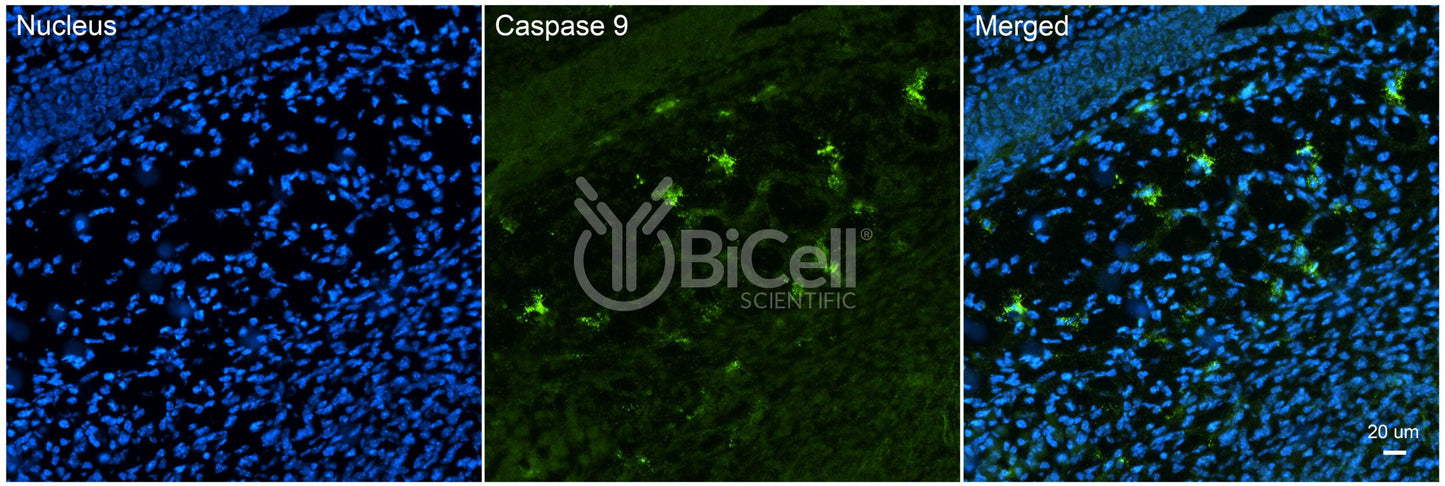
Scientific Overview
This antibody helps you characterize Caspase-9 while keeping condition-to-condition contrasts straightforward. Caspase-9 is a protein of interest for mapping abundance changes across conditions and cell states. Use matched handling so differences reflect biology rather than processing.
Tracking Caspase-9 can clarify whether changes reflect regulation, redistribution, or altered complex assembly.
Research Relevance
In many projects, target-level measurements help link perturbations to downstream phenotypes. Define inclusion criteria and controls early so replicate sets remain interpretable as the dataset grows.
Since many cellular processes are coupled, measured differences can reflect both direct regulation and indirect effects from broader state changes.
When building a narrative around the target, it helps to track:
- subcellular compartment mapping
- interpretation alongside orthogonal readouts
- baseline versus stimulated condition comparisons
- cross-sample normalization strategies
Application-Specific Context
If your project spans exploratory questions, the regular version offers a balanced option for establishing baseline signal behavior. Think about how preparation affects epitope accessibility, and interpret patterns alongside morphology and compartment markers as needed. A short pilot series can help set exposure ranges and reduce reruns.
If your study spans multiple model systems, it can help to define a shared reference condition for Caspase-9 so cross-sample contrasts stay meaningful.
When interpreting Caspase-9, consider whether changes track with compartment identity, cell density, or perturbation timing; these factors can influence apparent signal without implying a direct causal link.
With consistent handling, the regular format format can make Caspase-9 comparisons easier to reproduce across runs.
- Targets:
- CASP9
- Research Area:
- Apoptosis
- Application:
- IF • IHC • WB
- Reactivity:
- Human • Mouse • Rat
- Host:
- Rat
- Clonality:
- Polyclonal
- Isotype:
- IgG
- Immunogen:
- Synthetic peptide (14-aa) derived from the C-terminal region of human Caspase-9 protein (p10 subunit)
- Conjugation:
- Unconjugated
- Purification:
- Affinity Chromatography
- Concentration:
- 0.25 mg/ml
- UniProt:
- P55211
- Homology:
- Synthetic peptide sequence is identical to mouse or rat sequence
- Storage Buffer:
- PBS, pH 7.2, 0.1% Sodium Azide
- Storage Temperature:
- -20°C