
Caspase-4 (CASP4) Antibody - FFPE Validated

BiCell Scientific
SKU:10304-FFPE-50UL
Couldn't load pickup availability
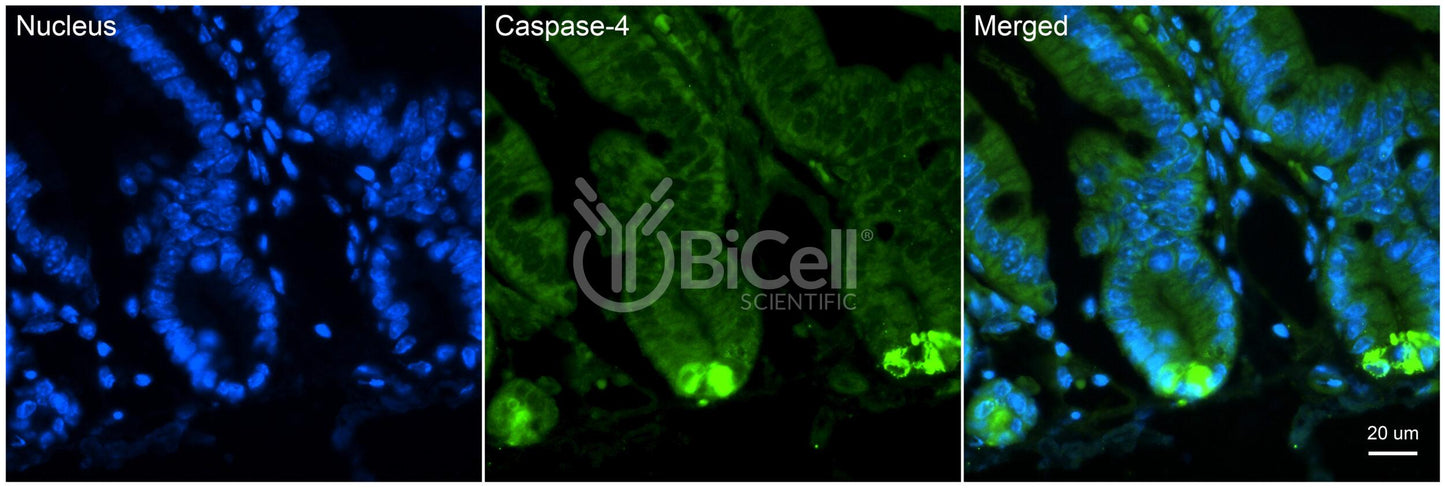
Protein Function
Bring Caspase-4 (CASP4) into view to characterize changes across conditions. Caspase-4 is a target that supports characterization of cellular state through expression and localization readouts. Look for shifts in distribution that track with phenotype changes.
In some datasets and protocols, it is referenced by the gene symbol CASP4.
Experimental Applications
Integrating localization with abundance measurements can clarify whether changes reflect trafficking or regulation. Pair measurements with orthogonal readouts when interpretation is sensitive to context.
Target-centric readouts can be framed around localization, relative abundance, or complex behavior, depending on the question you are testing.
Common experimental questions that benefit from target tracking include:
- subcellular compartment mapping
- baseline versus stimulated condition comparisons
- interpretation alongside orthogonal readouts
- cross-sample normalization strategies
Workflow Perspective
For paraffin-embedded samples, fixation history and retrieval strategy matter; this option is aligned to those constraints. To keep comparisons consistent, align sample preparation steps and define a clear baseline for each series.
If your study spans multiple model systems, it can help to define a shared reference condition for Caspase-4 so cross-sample contrasts stay meaningful.
For challenging targets, pairing Caspase-4 measurements with a second marker can clarify whether differences arise from regulation, redistribution, or shifts in cell composition within the sample.
To support downstream analysis, record key context variables (culture timing, stimulation window, and extraction approach) so Caspase-4 patterns can be compared across experiments without guesswork.
Select the fixed-section version to keep Caspase-4 (CASP4) interpretation aligned with your workflow goals.
- Targets:
- CASP4
- Research Area:
- Apoptosis • Inflammation
- Application:
- IHC-P
- Reactivity:
- Human • Mouse • Rat
- Host:
- Rat
- Clonality:
- Polyclonal
- Isotype:
- IgG
- Immunogen:
- Synthetic peptide (16-aa) derived from the C-terminal region of mouse Caspase-4 protein (p10 subunit)
- Conjugation:
- Unconjugated
- Purification:
- Affinity Chromatography
- Concentration:
- 0.25 mg/ml
- UniProt:
- P49662
- Homology:
- Synthetic peptide sequence is identical to rat sequence (showing 75% homology to human sequence)
- Storage Buffer:
- PBS, pH 7.2, 0.1% Sodium Azide
- Storage Temperature:
- -20°C