
Calpeptin

Selleck Chemicals
SKU:S7396-10MG
Couldn't load pickup availability
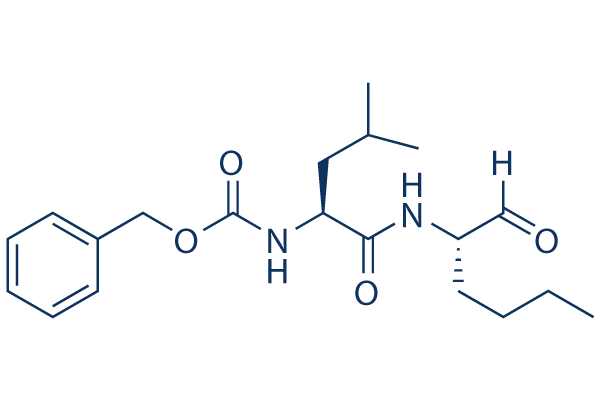
Calpeptin is an inhibitor of Cysteine Proteases used in studies of Apoptosis. It is especially relevant in apoptosis, cancer, and inflammation models, where defined compound exposure can be linked to caspase-associated cell-death signaling and survival decisions.
By inhibiting Cysteine Proteases, Calpeptin can be used to examine caspase-associated cell-death signaling and survival decisions. The protease annotation adds relevance to protease-activity, cleavage, and substrate-processing assays, together with downstream-response mapping in the same experimental setting. In apoptosis, cancer, and inflammation models, these readouts can be combined with viability, reporter, localization, biochemical conversion, or morphology endpoints to refine experimental interpretation.
Research Applications
- Target-focused assays involving Cysteine Proteases
- Pathway perturbation studies connected to Apoptosis
- Concentration-response inhibition and target-dependence studies
- Protease-activity, cleavage, and substrate-processing assays
Overall, Calpeptin is appropriate when a defined chemical perturbant is needed to connect Cysteine Proteases with measurable biochemical, transcriptional, electrophysiological, imaging, or phenotypic readouts in apoptosis, cancer, and inflammation models. This profile is suited to mechanistic follow-up, comparative profiling, and assay optimization under defined exposure conditions.
- Targets:
- Cysteine Proteases
- Target Class:
- Protease
- Pathways:
- Apoptosis
- Research Area:
- Apoptosis • Cancer • Inflammation
- CAS No.:
- 117591-20-5
- Molecular Weight:
- 362.46
- Formula:
- C₂₀H₃₀N₂O₄
- SMILES:
- CCCCC(C=O)NC(=O)C(CC(C)C)NC(=O)OCC1=CC=CC=C1
- Storage Temperature:
- -20°C
For Research Use Only. Not intended for diagnostic or therapeutic use.
Products may be subject to intellectual property rights.
The purchase of this product does not grant any license for commercial use, manufacturing, or clinical applications. The user is responsible for ensuring compliance with applicable laws and third-party rights.